AI Food Ordering & Delivery Software Solution for Restaurants
04 November, 2026


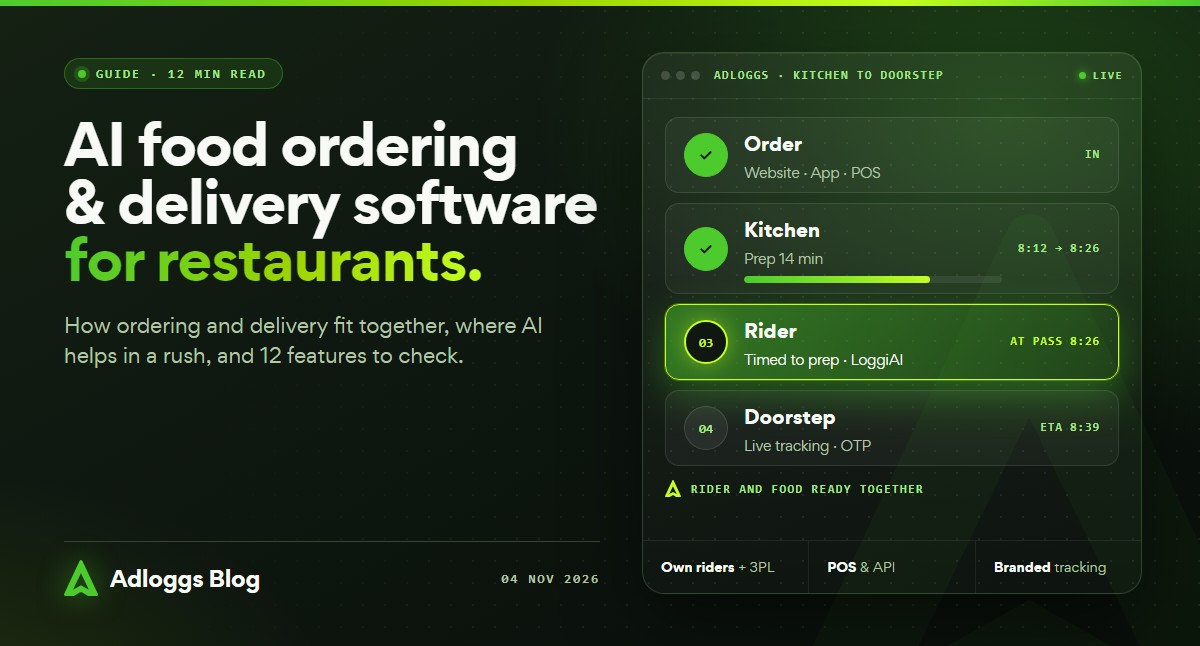
A restaurant selling online needs two kinds of software: one to take the order and one to deliver it. Here is how food ordering and delivery software fit together, where AI makes the difference in a dinner rush, and what to look for in a delivery software solution for your restaurant.
AI food ordering and delivery software for restaurants takes an order from your website, app, WhatsApp or POS, sends it to the kitchen, then uses AI to assign the right rider at the right moment, plan the route and track the food to the customer's door. Ordering software wins the order; delivery software keeps the promise. Adloggs is the AI delivery side of that pair: it connects to the POS and ordering platform you already use and runs delivery with your own riders and 3PL partners, across 60+ Indian cities.
The opportunity is large. The NRAI India Food Services Report 2024 values Indian food services at ₹5.69 lakh crore, growing to ₹7.76 lakh crore by 2028, with the organised share rising from 43.8% to 52.9%. And the last mile is the costliest leg of any delivery, at 41% of supply-chain costs. For a restaurant, it is also the leg where good food goes cold. Published by Adloggs.
It is two jobs that many restaurants buy separately but need to run as one:
A delivery software solution for restaurants joins the two, so dispatch knows what the kitchen knows. Here is the full stack and where Adloggs fits:
| Layer | What it does | Adloggs' role |
|---|---|---|
| Ordering channels | Your website, app, WhatsApp, marketplace and phone orders | Connects to them: orders arrive through your POS, ordering platform or the Adloggs API |
| POS and menu | Billing, menu, prices and kitchen tickets | Integrated, so orders from every outlet land in one delivery queue |
| Kitchen | Cooking and packing | Reads each order's prep time to plan dispatch around it |
| Dispatch | A rider or partner for each order | LoggiAI picks your own rider or a 3PL partner, timed to the food |
| Routing | Trips and order clubbing | Routa clubs orders going the same way when the delivery promise allows |
| Tracking and support | Live tracking, alerts and “where is my order?” | Branded tracking link on WhatsApp or SMS; Zoya on WhatsApp, Vox on calls |
| Supervision and analytics | SLA risk, cost per order, outlet reports | ControlX control tower and outlet-by-outlet reports |
| Question | Food ordering software | Delivery software |
|---|---|---|
| Main job | Win and record the order | Deliver it on time at the lowest cost |
| Who uses it | Customers and counter staff | Dispatchers, outlet managers and riders |
| Key data | Menu, cart, payment, customer details | Prep time, rider location, distance, traffic, partner capacity |
| Where AI helps | Varies by vendor | Rider assignment, own rider or 3PL, order clubbing, SLA risk |
| Success measure | Conversion and order value | On-time rate and cost per delivered order |
Many restaurants already have ordering software that works. The gap usually opens after the kitchen ticket prints: riders booked by phone, a WhatsApp group per outlet, and customers calling to ask where their food is. That is the part manual dispatch can't scale, and the part this guide is about.
In a dinner rush, a dispatcher makes hundreds of small decisions an hour. Adloggs AI agents make the routine ones in real time; your team handles the exceptions and can always override the AI.
LoggiAI, the Adloggs AI allocation engine, reads the order's prep time, rider availability, distance and traffic, and assigns a rider so they reach the pass as the food is ready: not before, and not after. How LoggiAI allocates orders.
Your riders take orders first. When they are busy, LoggiAI weighs fleet load, partner capacity, the delivery SLA and cost, and sends the overflow to the right connected partner, from the same dashboard. Multi-carrier delivery management.
Routa, the routing agent, clubs orders going the same way into one trip when it won't break either delivery promise. Routa route optimization.
ControlX, the AI control tower, watches every order, scores its SLA risk and acts before a breach, with AI voice calls and WhatsApp to riders, rider reassignment and escalation. The customer gets a proactive alert if anything changes. The ControlX control tower.
Zoya, the AI support agent, answers order questions on WhatsApp, and Vox, the AI voice agent, takes delivery calls, so staff pack orders at peak instead of answering the phone. Zoya on WhatsApp.
VerifyOS checks every rider with an ID match, face match and liveness check before their first order, the same way at every outlet. VerifyOS rider verification.
On the ordering side, AI features such as item suggestions or demand forecasts vary from vendor to vendor. Whatever your ordering software offers, ask to see it working on your own menu and orders before you pay for it.
Illustrative example: one dinner order on a restaurant's own website, with the AI decisions above in sequence.
Nobody at the outlet phoned a rider, and nobody answered a “where is my order?” call. See the same flow, step by step, on the restaurant delivery management software page.
Most Indian restaurants use more than one model. The delivery software decides which one each order takes.
| Model | How it works | Best for | Watch out for |
|---|---|---|---|
| Marketplace delivery | The marketplace's riders deliver marketplace orders | Discovery and new customers | Commission on every order; the marketplace holds the customer relationship |
| Own riders (1PL) | Your riders, on your rider app | Steady volume near the outlet | Idle cost in quiet hours, too few riders at peak |
| 3PL partners on demand | Partner riders booked per order | Peaks, far zones and new outlets | Acceptance varies by area and hour |
| Hybrid: own riders first, 3PL overflow | A core fleet sized for average demand, plus partners for peaks | Most chains and cloud kitchens | Needs software that chooses for every order |
For orders on your own website, app or WhatsApp, the hybrid lets you deliver without marketplace riders, so you keep the customer and avoid marketplace delivery commissions. Rider supply matters too: NITI Aayog counted 7.7 million gig workers in India in 2020–21, projected to reach 23.5 million by 2029–30, and restaurants share that pool with every other delivery business. A core fleet of your own riders, managed on one rider app with onboarding, shifts and scorecards, plus partners on call, is the safest way to cover a peak.
| # | Feature | Why it matters for a restaurant |
|---|---|---|
| 1 | Order intake from POS, ordering platforms and API | Every channel and outlet in one queue, with no re-typing |
| 2 | Kitchen-aware dispatch | Riders arrive as the food is ready, so neither the rider nor the food waits |
| 3 | Own riders and 3PL partners in one dashboard | Peaks are covered without hiring for the busiest hour |
| 4 | Automatic fallback between partners | An order doesn't sit unassigned when a partner doesn't accept |
| 5 | Order clubbing and route planning | Fewer trips, without breaking delivery promises |
| 6 | Rider app with live GPS | Location and status without phone calls |
| 7 | Branded live tracking on WhatsApp or SMS | The customer sees your restaurant, not a partner's page |
| 8 | Proactive delay alerts | Customers hear about a delay before they have to ask |
| 9 | Proof of delivery or OTP | Fewer disputes, especially on cash orders |
| 10 | Prepaid and cash on delivery | Both payment types run through the same delivery flow |
| 11 | Every outlet in one view, with role-based access | Head office and outlet managers each see what they need |
| 12 | Outlet-by-outlet reports | Delivery time, cost per order and SLA, so you know which outlet, zone or partner to fix |
Adloggs covers all twelve in its delivery management software, and custom ordering systems connect through the Adloggs REST API and webhooks.
Measure per outlet and per hour, not per city and per month, or the rush-hour problems disappear into the average.
| KPI | Definition | What it tells you |
|---|---|---|
| Rider wait at the pass | Minutes between the rider's arrival and the food being ready | High means dispatch is too early, and you pay riders to stand |
| Food wait at the pass | Minutes the packed food waits for a rider | High means dispatch is too late, and food goes cold |
| Time to assign | Minutes from order to an accepted rider | The first number to break at peak |
| On-time rate | Share of orders delivered inside the promised time | The number your customers feel |
| Cost per delivered order | Rider or partner cost, plus the cost of failures, per delivered order | The fair way to compare own riders with partners |
| “Where is my order?” contacts | Calls and chats per 100 orders | Shows whether tracking and alerts are working |
Adloggs real-time delivery analytics shows on-time rate, delivery times, cost per order and cancellations by outlet, zone, partner, rider and hour. When an order is late, root cause analysis traces it to the stage that slipped: prep, rider assignment, pickup, transit or handover.
The order is digital until the kitchen ticket prints, then it becomes a phone call. Connect ordering to delivery so the rider is booked without anyone touching the order.
A rider sent at order time waits at the pass while the food cooks; one sent too late leaves food going cold. Time dispatch to prep.
Your partner is busiest exactly when you are. Keep your own riders first and spread the overflow across partners by area.
If the tracking link shows a partner's brand, the customer relationship goes with it. Use tracking and alerts in your own brand.
Compare cost per delivered order, including the late, failed and cancelled ones. The cheapest trip is not always the cheapest delivery.
Rules for each partner and area are set in delivery partner setup, and the hyperlocal delivery services page lists every city Adloggs serves.
Food ordering software wins the order. Delivery software decides whether the customer orders again. Keep the ordering tools that work for you, connect them to delivery software that times every rider to your kitchen, and judge it on on-time rate and cost per delivered order. For the wider picture, read what the best delivery management software in India must do, the kinds of hyperlocal delivery software and what a delivery operating system is.
It is the software that takes a restaurant's online orders and delivers them. The ordering side handles the menu, cart, payment and kitchen ticket. The delivery side uses AI to assign each order to a rider timed to kitchen prep, choose between own riders and 3PL partners, plan the route, track the order live and confirm delivery.
Food ordering software wins and records the order: menu, cart, payment and the ticket to the kitchen. Delivery software gets the order to the customer: rider assignment, routing, live tracking and proof of delivery. Restaurants often buy them separately and connect them through the POS or an API.
No. Adloggs is the delivery side. It connects to the POS and ordering platform a restaurant already uses, and to custom systems through its REST API and webhooks. For merchants who manage orders on an ordering website, Adloggs Dispatch captures each order in Chrome and books a rider automatically.
For restaurants that run their own riders, use 3PL partners, or both, Adloggs offers AI dispatch timed to kitchen prep, own riders and 3PL partners in one dashboard, branded live tracking and outlet-by-outlet reports, across 60+ Indian cities and 30,000+ daily transactions.
Yes. For orders from its own website, app or WhatsApp, a restaurant can deliver with its own riders and 3PL partners through Adloggs, keeping the customer relationship and avoiding marketplace delivery commissions.
AI times riders to kitchen prep so they don't wait at the pass, clubs nearby orders into one trip, keeps own riders busy on steady volume and sends peak overflow to the best-fit 3PL partner. Adloggs does this order by order and reports cost per order by outlet.
Yes. Cloud kitchens, franchise networks and restaurant chains run every outlet from one Adloggs dashboard, with role-based access for outlet managers and head office and reports for each outlet.
Yes. Every customer gets a live-tracking link in the restaurant's brand on WhatsApp or SMS, proactive alerts if anything changes, and delivery confirmed with proof of delivery or OTP.
Examples marked as illustrative show typical scenarios, not results from a specific customer.
Adloggs is an AI-powered delivery operating system for India and beyond, offering smart delivery orchestration, AI-driven routing, partner aggregation, and hyperlocal logistics for enterprises, QSRs, grocery, pharmacy, restaurant, and ecommerce brands.
Made within India
Adloggs Technologies Private Limited,
Sri Krishna Towers, Thirumurugan Nagar Road, Periyar Nagar, Nehru Nagar West, Coimbatore, Tamil Nadu 641048.
© 2026 - 2027 Adloggs All Rights Reserved