Unify your entire delivery ecosystem with Adloggs
16 October, 2026


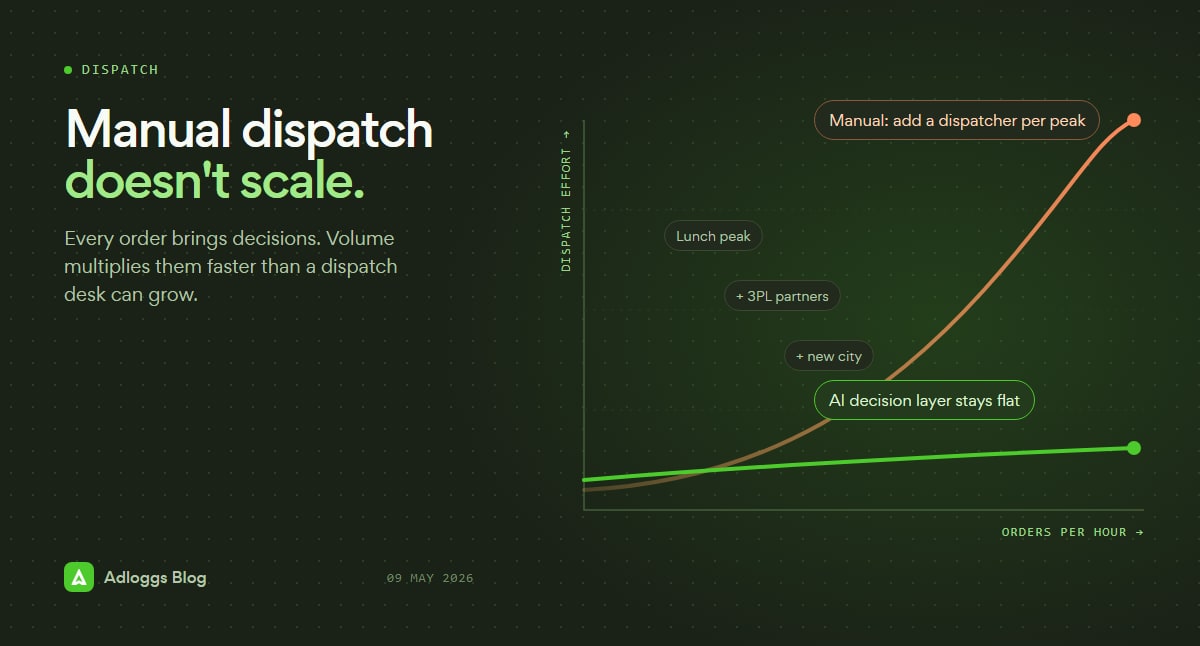
Manual dispatch doesn’t scale — and most operations teams already know it, they just haven’t had a system that could take over the decision layer.
Every order that enters a delivery operation brings a handful of decisions with it: who takes it, whether it can be batched, which route to use, what arrival time to promise, and what to do when the kitchen, the traffic or the rider doesn’t cooperate. Call it five decisions per order.
In an illustrative operation running 2,000 orders a day, that is 10,000 decisions a day, clustered into a few peak hours. A good dispatcher makes them well. Nobody makes them well at that rate for a whole shift, and hiring a second, third and fourth dispatcher adds coordination problems of its own.
Lunch, dinner, weekends and festive days compress the day’s decisions into a few hours. Response time rises exactly when customers are least patient. And patience is shrinking: India’s quick commerce market is forecast to reach US$12.97 billion by 2029, growing 17.6% a year from 2025, which keeps resetting what “fast” means for everyone else.
Once you run your own riders alongside agencies and 3PL partners, every allocation becomes a comparison of cost, availability and past performance across portals. Dispatchers fall back on the partner they know, which is rarely the cheapest or the fastest for that zone and hour.
A new city means new riders, new partners and new traffic patterns. Knowledge that lived in one dispatcher’s head doesn’t transfer, so each launch starts from zero.
An AI dispatch system doesn’t replace the team. It takes the routine decisions off the desk:
Dispatchers move from assigning orders to managing exceptions, partners and customers, which is the work that actually needs their judgement. With the last mile at 41% of supply-chain costs (Capgemini), better allocation on every order is where the savings are.
At each step, compare on-time rate and cost per order against the previous month. Automation should earn each widening of its remit.
Teams don’t stay on manual dispatch because they like it; they stay because nothing could take the decisions over. The Adloggs delivery management system and its agentic AI suite are built to do exactly that, while keeping every override in your team’s hands.
Each order needs several decisions: who delivers it, whether to batch it, which route to take, what ETA to promise and what to do when something slips. Order volume multiplies those decisions, and a dispatch desk can only grow one person at a time.
It is the set of choices made between an order arriving and a rider being on the way: allocation, batching, routing and exception handling. An AI dispatch system makes those choices on every order using live data, and escalates only what needs a person.
Start with the system recommending while dispatchers decide, then let it act on routine orders within set rules, and finally keep people for exceptions only. Compare SLA and cost per order at each stage before widening automation.
Examples marked as illustrative show typical scenarios, not results from a specific customer.
Adloggs is an AI-powered delivery Operating System for India and beyond, offering smart delivery orchestration, AI-driven routing, partner aggregation, and hyperlocal logistics for enterprises, QSRs, grocery, pharmacy, restaurant, and ecommerce brands.
Adloggs Technologies Private Limited,
Sri krishna towers, Thirumurugan Nagar Road, Periyar Nagar, Nehru Nagar West, Coimbatore, Tamil Nadu 641048.
© 2026 - 2027 Adloggs All Right Reserved