Unify your entire delivery ecosystem with Adloggs
16 October, 2026


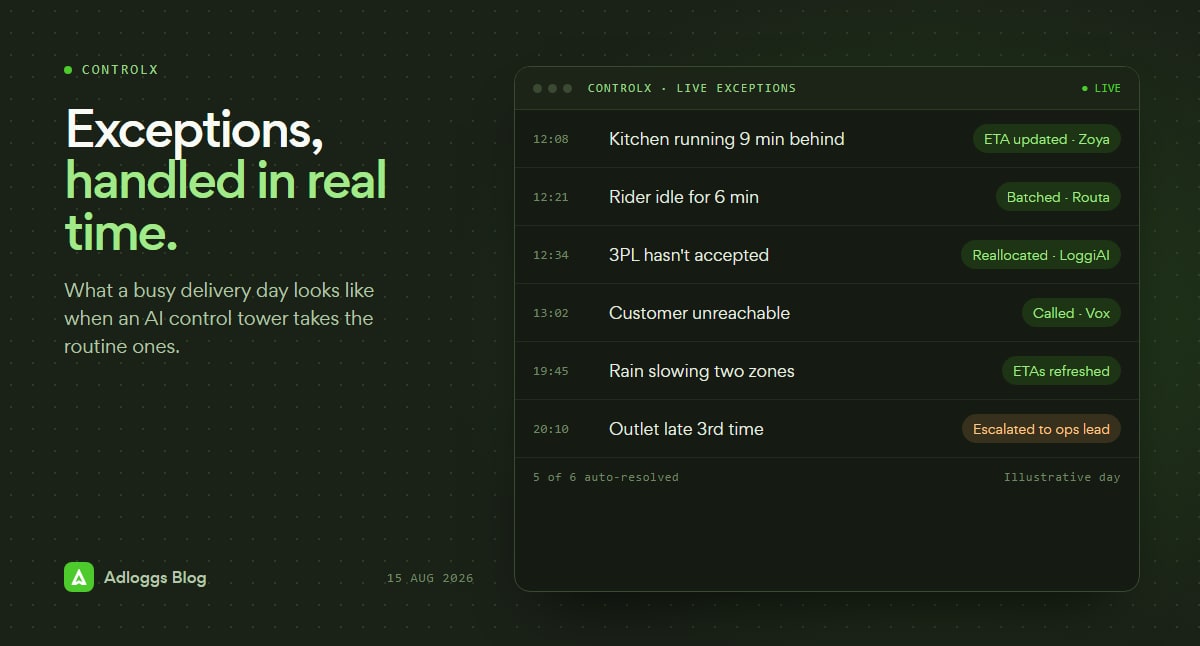
Real-time delivery management is mostly exception management. Here is what a busy day looks like when an AI control tower handles the routine exceptions and your team handles the rest.
The timeline below is illustrative, built from the kinds of exceptions any food or quick-commerce operation sees on a weekday. The pattern is what matters: each exception is caught early and routed to the agent built to fix it.
| Time | What ControlX sees | What happens |
|---|---|---|
| 12:08 | Kitchen at one outlet running 9 minutes behind | ETAs recalculated; Zoya updates the affected customers on WhatsApp |
| 12:21 | Rider idle for 6 minutes near a busy cluster | Routa batches a nearby pickup into the rider’s next trip |
| 12:34 | 3PL partner hasn’t accepted a booking | LoggiAI reallocates the order to the next partner in the fallback order |
| 13:02 | Customer unreachable at the door | Vox calls the customer before the rider leaves |
| 19:45 | Rain slows traffic across two zones | ETAs refreshed zone-wide; high-priority orders moved to the nearest available riders |
| 20:10 | Same outlet late for the third time today | Escalated to the operations lead with the pattern attached |
Five of those six exceptions never reached the dispatch desk. The sixth reached it with the evidence already assembled.
A useful rule: automate the exceptions that are frequent and have one right answer; keep people for the ones that are rare or expensive.
Customer expectations keep compressing. India’s quick commerce market is forecast to grow 17.6% a year to US$12.97 billion by 2029, and every ten-minute delivery someone else makes raises the bar for yours. An exception handled in minutes instead of after the complaint is the difference between a delay and a lost customer.
That is why response time is part of how Adloggs measures ControlX: it reports under 1 second AI response time, 2.8M+ orders supervised and a 97.8% SLA defense rate.
Real-time delivery management works when people stop firefighting routine exceptions. ControlX, working with the rest of the Adloggs Agentic AI suite, handles those, so your team can focus on the few decisions that truly need them.
It is managing orders while they are in progress: watching preparation, pickup and the trip, and correcting course when something changes. Most of the work is handling exceptions before they turn into late or failed deliveries.
Repeatable ones with a clear best response: recalculating ETAs when preparation runs late, reallocating an order a partner hasn't accepted, batching an idle rider with a nearby order and notifying customers of changes. Unusual or costly decisions should stay with people.
Agree in advance which exceptions the system handles automatically, which partners are fallbacks in each zone, what customers are told about delays, and who on the team owns escalations during each peak window.
Examples marked as illustrative show typical scenarios, not results from a specific customer.
Adloggs is an AI-powered delivery Operating System for India and beyond, offering smart delivery orchestration, AI-driven routing, partner aggregation, and hyperlocal logistics for enterprises, QSRs, grocery, pharmacy, restaurant, and ecommerce brands.
Adloggs Technologies Private Limited,
Sri krishna towers, Thirumurugan Nagar Road, Periyar Nagar, Nehru Nagar West, Coimbatore, Tamil Nadu 641048.
© 2026 - 2027 Adloggs All Right Reserved