Best 3PL Partner Aggregation in India
09 November, 2026


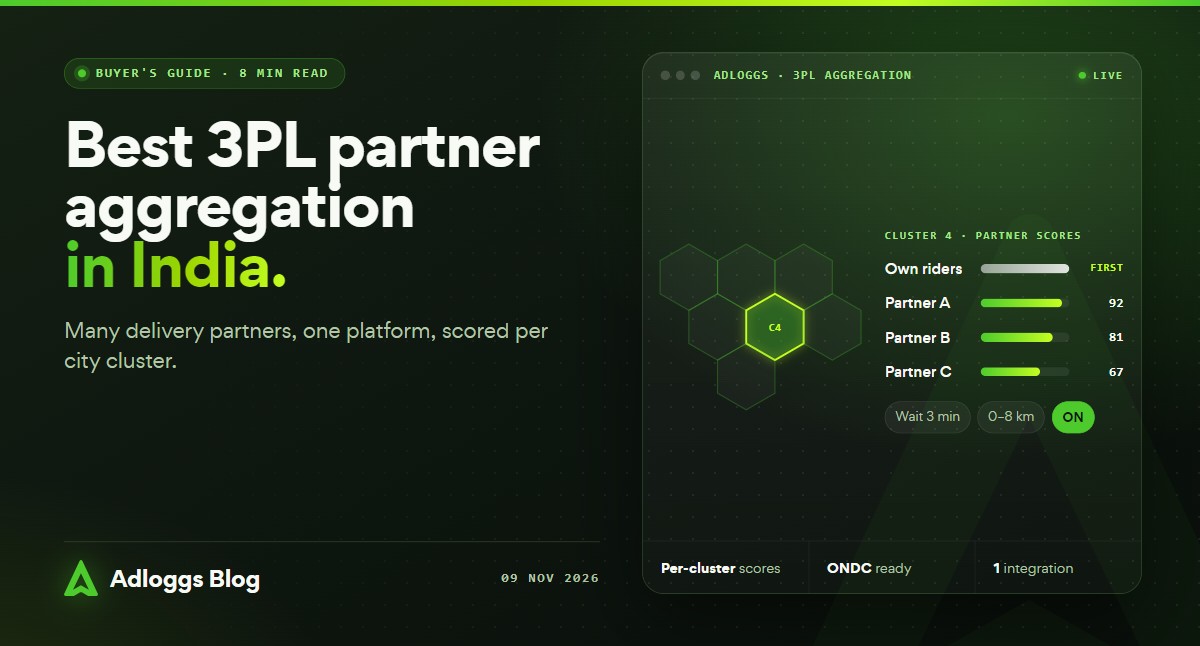
3PL partner aggregation connects many third-party delivery partners through one platform and one integration, then chooses the best one for each order. Here is how it works, why one partner is not enough in India, and how to choose a platform.
The best 3PL partner aggregation in India connects many delivery partners through one platform, scores each one per city cluster on acceptance, success and cost, applies your rules for every partner and keeps your own riders first. Adloggs aggregates 3PL partners and the ONDC logistics network this way, across 60+ Indian cities.
The stakes are high: the last mile accounts for 41% of supply-chain costs, and the DPIIT–NCAER study found that smaller firms face significantly higher logistics costs. Partner choice is one of the few levers that moves both cost and on-time rate. Published by Adloggs.
A 3PL (third-party logistics) delivery partner is a company whose riders deliver your orders for a fee. Partner aggregation brings many of them into one platform, so you integrate once, see every partner in one dashboard and choose between them for each order, instead of managing a portal, a contract and a phone number per partner.
| Model | How it works | Trade-off |
|---|---|---|
| Single 3PL partner | One partner takes all outsourced orders | Simple to start; one point of failure at peak |
| 3PL partner aggregation | Many partners connected through one platform and one integration, chosen per order | Capacity, fallback and cost comparison in one place |
| Multi-carrier delivery management | Aggregation plus per-order carrier choice, rules and tracking for every carrier | Brands that want control over who delivers what |
| Delivery orchestration | The wider layer that decides across own riders, carriers and 3PL partners | Businesses mixing own fleet and partners |
With Indian quick commerce forecast to reach US$12.97 billion by 2029, peaks are getting bigger, not smaller.
Your rules always come first. For each partner you can set:
Own riders can take nearby orders first, with the overflow going to the next best partner, or LoggiAI can choose between riders and partners for every order. See the details, and the current list of connected partners, on the multi-carrier delivery management page.
Adloggs works with the ONDC logistics network in three roles: logistics buyers use it to discover and select delivery partners on ONDC across categories and pin codes, logistics sellers use it to list and manage their capacity, and as a technology service provider it offers ONDC-ready APIs, dashboards and apps.
Adloggs Dispatch brings partner aggregation to local shops and restaurants. It captures orders from the ordering website a merchant already uses and books a rider on the merchant's chosen partners in priority order, with a timed fallback to the next partner. The Adloggs service charge applies only to delivered orders.
Aggregation only pays off if you compare partners on the right numbers, per cluster and per hour rather than per city and per month.
| Metric | Definition | Why it matters |
|---|---|---|
| Acceptance rate | Share of offered orders the partner accepts within your waiting time | A low rate means orders wait and fall back, eating the delivery window |
| Time to accept | Minutes from offer to an accepted rider | Decides whether the order leaves on time at peak |
| Delivery success | Share of accepted orders delivered without failure or return | Failures cost a second trip and a customer contact |
| On-time rate | Share delivered inside the promised window | The number your customers actually feel |
| Cancellations | Orders the partner cancels after accepting | The most expensive failure: it happens after you stopped looking |
| Cost per delivered order | Partner fares plus the cost of fallbacks and failures, per delivered order | The fair way to compare a cheap partner with a reliable one |
Adloggs real-time delivery analytics shows 3PL partner scores, cost per order and cancellations by outlet, zone, partner and hour, and the same outcomes feed the LoggiAI scores that decide tomorrow's allocation.
Illustrative example: a restaurant chain in two cities that used one delivery partner for every outsourced order.
A partner that is fast in one part of a city can be slow in the next. Score per cluster.
Access to ten partners is noise without waiting times, distance limits and priorities.
Keep your riders busy on nearby orders first, and use partners for overflow and far zones.
Compare cost per delivered order: a cheap partner that misses acceptance costs you a second booking and a late order.
If status lives in many portals, nobody sees the whole picture, and customers call.
Aggregation works both ways. Delivery agencies can join the Adloggs partner network through the agency onboarding form (linked below), and run their riders for every client on Adloggs: each client's orders in one queue, AI rider assignment by shift and zone, and SLA reporting per client. See delivery partner setup, the Adloggs partner ecosystem and software for delivery agencies.
Partner aggregation turns several delivery partners from a list of contacts into one capacity pool that works by area, by rule and by result. To see where it fits in the bigger picture, read how to choose delivery orchestration software and what the best last-mile delivery software must improve.
3PL partner aggregation means connecting many third-party logistics (3PL) delivery partners through one platform and one integration, then choosing a partner for each order. It adds capacity at peak, gives you a fallback when a partner is short of riders, and lets you compare partners on cost and performance in one dashboard.
For businesses that want several delivery partners alongside their own riders, Adloggs aggregates 3PL partners and the ONDC logistics network in one platform. LoggiAI scores every partner per city cluster on acceptance, success and cost, and your rules for each partner always apply, across 60+ Indian cities.
They overlap. A 3PL aggregator gives you access to many delivery partners; multi-carrier delivery management also decides which partner takes each order, applies your rules and tracks every partner in one place. Adloggs does both.
LoggiAI weighs demand, partner performance, rider availability, traffic, distance and cost for every order, and predicts each partner's acceptance, delivery success and cost in that order's city cluster. The order goes to the best fit within your waiting time, distance range and on/off rules for each partner.
Adloggs connects to a range of national and regional delivery partners and the ONDC logistics network. The current list is on the Adloggs multi-carrier delivery management page, and availability varies by city.
Yes. Delivery agencies can join the Adloggs partner network through the agency onboarding form and run their own operation on Adloggs, with every client's orders in one queue. Logistics sellers can also list and manage their capacity on ONDC through Adloggs.
Examples marked as illustrative show typical scenarios, not results from a specific customer.
Adloggs is an AI-powered delivery operating system for India and beyond, offering smart delivery orchestration, AI-driven routing, partner aggregation, and hyperlocal logistics for enterprises, QSRs, grocery, pharmacy, restaurant, and ecommerce brands.
Made within India
Adloggs Technologies Private Limited,
Sri Krishna Towers, Thirumurugan Nagar Road, Periyar Nagar, Nehru Nagar West, Coimbatore, Tamil Nadu 641048.
© 2026 - 2027 Adloggs All Rights Reserved