Unify your entire delivery ecosystem with Adloggs
16 October, 2026


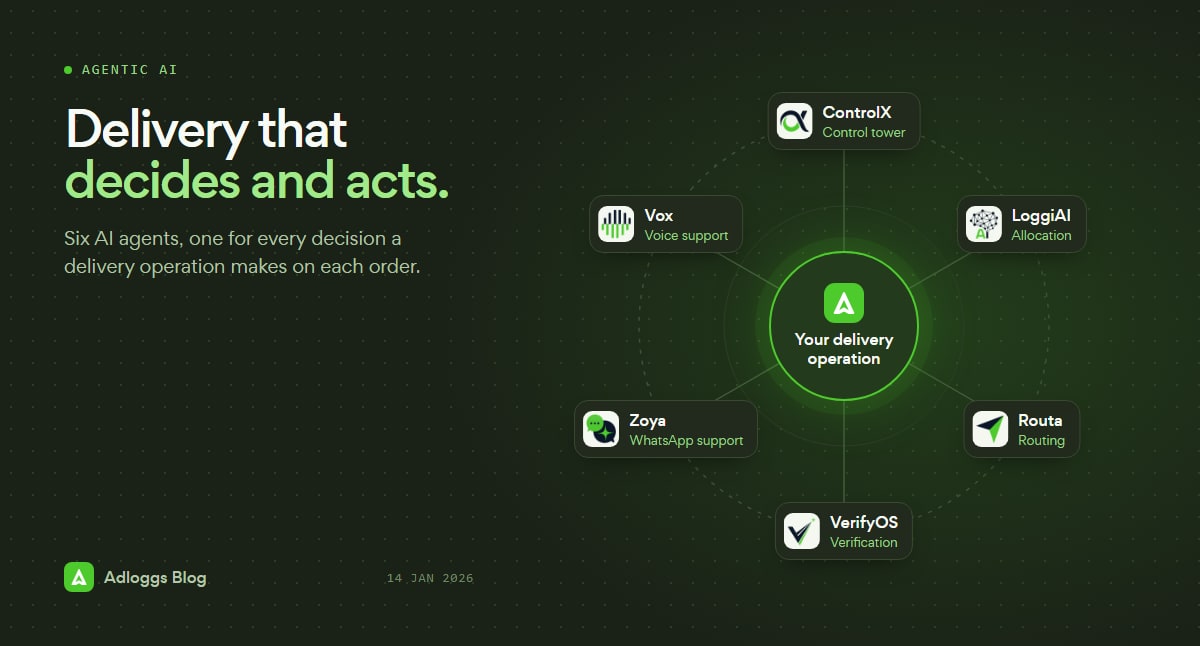
Most delivery teams already have dashboards. What they lack is software that acts on what the dashboard shows. That is the shift agentic AI brings to delivery operations.
For years, delivery software has been good at showing what is happening: where riders are, which orders are late, how a partner performed last week. Someone still has to look at that screen and decide what to do next. On a busy lunch service, that someone is a dispatcher juggling phone calls, WhatsApp groups and three partner portals.
Agentic AI changes the job of the software. Instead of only reporting, an AI agent observes the live situation, decides on the next step and carries it out, within limits your team sets. When the situation falls outside those limits, it escalates to a person with the context already attached.
The last mile is the most expensive part of the chain. Capgemini’s research puts last-mile delivery at 41% of overall supply-chain costs, more than any other stage. Every avoidable reassignment, idle minute or failed attempt lands in that 41%.
The rider pool is also growing fast. NITI Aayog estimated 7.7 million gig and platform workers in India in 2020–21 and projects 23.5 million by 2029–30. More riders, more partners and more order channels mean more decisions per hour than any dispatch desk can make by hand.
Adloggs breaks delivery operations into the decisions that repeat on every order, and gives each one to a specialised agent:
Here is how the agents work together on a single, illustrative lunch-time order:
Autonomy works when the boundaries are clear. Decide which actions agents can take alone (reassigning within a zone, updating ETAs, notifying customers) and which need approval (switching to a costlier partner, cancelling an order). Keep manual overrides available, and review escalations weekly to move routine cases into the automated set.
Pick the decision your team makes most often and gets wrong most expensively. For most operations that is allocation during peaks or customer “where is my order?” contacts. Automate that one decision, measure it for a month, then add the next agent. The Adloggs Agentic AI suite is built to be adopted this way, one agent at a time, on top of the Adloggs delivery management system.
Agentic AI is software that observes live delivery data, decides what to do and carries out the action itself, within limits set by the operations team. In delivery, that means allocating orders, planning routes, spotting SLA risk and updating customers without waiting for a person to click.
Route optimization answers one question, usually in a batch. An agentic system handles a chain of decisions continuously: it picks the rider or partner, plans the route, watches the trip and acts when something changes, such as reassigning the order or notifying the customer.
No. It takes over the repetitive decisions so dispatchers can manage exceptions, partners and customers. Manual controls stay available, and the team decides which actions the agents may take on their own.
Adloggs has six: LoggiAI for order allocation, Routa for routing and batching, VerifyOS for rider onboarding and verification, ControlX as the AI control tower, Zoya for WhatsApp customer support and Vox for voice support.
Examples marked as illustrative show typical scenarios, not results from a specific customer.
Adloggs is an AI-powered delivery Operating System for India and beyond, offering smart delivery orchestration, AI-driven routing, partner aggregation, and hyperlocal logistics for enterprises, QSRs, grocery, pharmacy, restaurant, and ecommerce brands.
Adloggs Technologies Private Limited,
Sri krishna towers, Thirumurugan Nagar Road, Periyar Nagar, Nehru Nagar West, Coimbatore, Tamil Nadu 641048.
© 2026 - 2027 Adloggs All Right Reserved