Best End-to-End Logistics Automation Platform for India
28 October, 2026


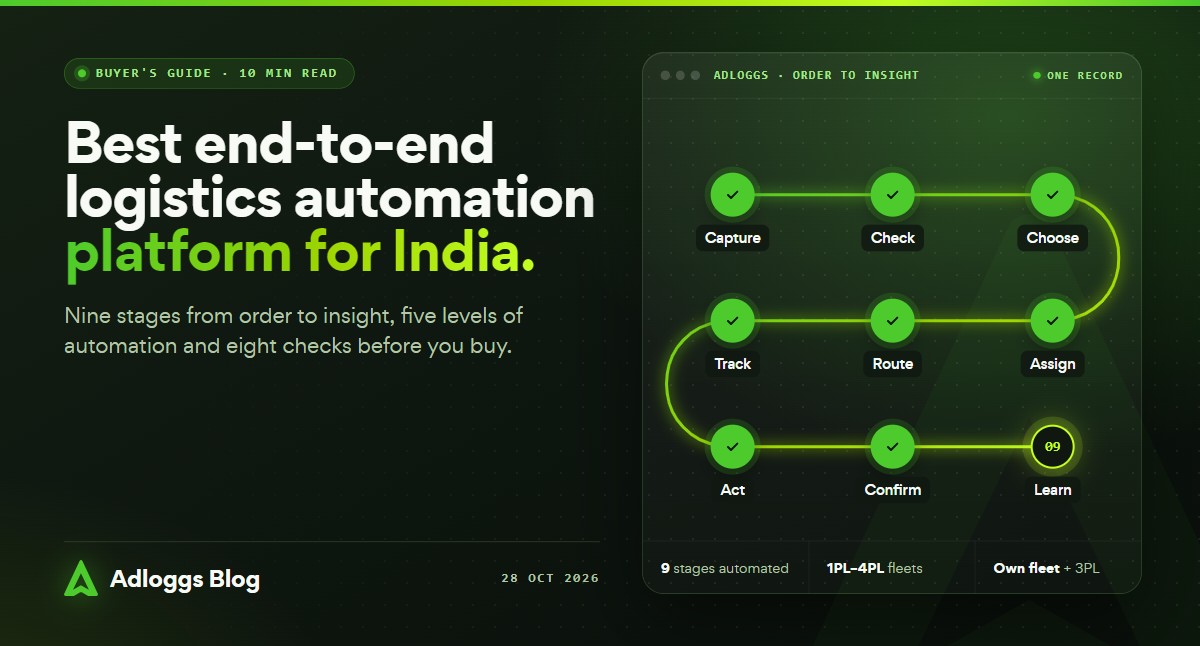
An end-to-end logistics automation platform runs every step of a delivery, from the order to the analysis after it, on one record and without hand-offs between tools. Here is what to automate, in what order, and how to choose the right platform for India.
The best end-to-end logistics automation platform for India runs every step of a delivery on one record (order, partner choice, rider, route, tracking, exceptions and analysis), works across your own riders and 3PL partners, and handles cash on delivery and city-by-city zones. Adloggs is built in India for that job, across 60+ Indian cities and 30,000+ daily transactions.
Why it matters now: India's logistics cost was 7.97% of GDP in 2023–24, about ₹24.01 lakh crore, according to the DPIIT–NCAER study, which also found that smaller firms face significantly higher logistics costs. The last mile alone accounts for 41% of supply-chain costs, and Indian quick commerce is forecast to reach US$12.97 billion by 2029. Every manual hand-off between an order and a doorstep adds to those numbers.
This guide covers the delivery side of logistics: from the moment an order is placed to the moment it is delivered and analysed. Warehousing and long-haul freight need their own systems. Published by Adloggs.
An end-to-end logistics automation platform is software that takes a delivery from order to insight without people moving data between tools. It captures the order, checks the address can be served, chooses the fleet or partner, assigns the rider, plans the route, keeps the customer informed, acts on delays, confirms delivery and explains what went wrong, all on one record.
"End to end" is the important part. Most businesses already have some automation: a tracking app here, a partner portal there. The cost hides in the gaps between them, where a dispatcher copies an address, a support agent calls a rider, or a manager rebuilds last week's numbers in a spreadsheet.
Here is the full lifecycle, what it looks like when it is manual, and what automation replaces it with.
| # | Stage | When it is manual | On Adloggs |
|---|---|---|---|
| 1 | Order capture | Orders copied by hand from each channel | Adloggs DMS |
| 2 | Serviceability check | Someone checks whether a rider can reach the address | Adloggs delivery API |
| 3 | Fleet or partner choice | Calls to partners to find spare capacity | Adloggs DOS |
| 4 | Rider assignment | A dispatcher rings riders one by one | LoggiAI |
| 5 | Routing and batching | Each rider decides the order of drops | Routa |
| 6 | Tracking and customer updates | "Where is my order?" calls to support, then to the rider | Zoya and Vox |
| 7 | Exception handling | Late orders found after the customer complains | ControlX |
| 8 | Proof of delivery and status sync | Rider names and statuses typed back into each system | Adloggs DMS |
| 9 | Analysis and root cause | A weekly spreadsheet that says what happened, not why | Adloggs root cause analysis |
Every order lands in one queue from POS, OMS, e-commerce platforms, marketplaces and the REST API, prepaid or cash on delivery.
Service availability is checked through the API before the order is confirmed, so the promise made to the customer is one the fleet can keep.
Your rules and AI decide, per order, whether your own riders, a dedicated carrier or a 3PL partner delivers it.
LoggiAI weighs distance, traffic, rider availability, delivery priority, cost and past performance, then assigns the best rider or partner.
Routa batches nearby orders and sequences multi-stop trips around rider capacity, SLA windows, live traffic and weather, and re-plans as they change.
Live GPS status and ETAs for the team and the customer. Zoya answers delivery questions on WhatsApp and Vox handles update calls by voice.
ControlX scores SLA risk on every active delivery and acts before a breach: it reassigns, escalates and reaches riders by AI voice call and WhatsApp.
Status updates flow back to your own systems by webhook, through to proof of delivery, with OTP checks where the workflow needs them.
Live analytics by outlet, zone, partner, rider and hour, and root cause analysis that traces each late order to the stage that slipped.
One supporting workflow runs alongside all nine: rider onboarding and verification. VerifyOS checks riders with facial recognition, ID matching, liveness detection and document checks, so the fleet can grow quickly without lowering standards.
Automation is not on or off. Most Indian delivery teams sit between level 1 and level 2. Find yours, then aim one level up.
The move from level 2 to level 3 is where most of the gain is, because rules cannot see live traffic, partner performance in a particular cluster or a rider who is running late. For how SLA monitoring changes along the way, read how to move from reactive to autonomous delivery operations.
Illustrative example: a restaurant chain with its own riders and connected delivery partners, on a busy Friday evening.
| Time | What the platform does |
|---|---|
| 8:05 pm | A Friday-night order reaches the delivery queue from the restaurant's POS, cash on delivery. The address is checked as serviceable. |
| 8:05 pm | The chain's own riders near the outlet are all on trips, so the rules allow a partner. LoggiAI scores the connected partners in that city cluster and assigns the best fit. |
| 8:06 pm | Routa pairs the order with another one for the same street from the same outlet, so one rider carries both. |
| 8:19 pm | Pickup is running late. ControlX flags the SLA risk, calls the rider by AI voice call, and reassigns the second order to a free rider before it breaches. |
| 8:24 pm | The customer asks on WhatsApp where the food is. Zoya answers with the live ETA; nobody at the store picks up the phone. |
| 8:41 pm | The order is delivered and marked complete. Status flows back to the restaurant's own systems by webhook. |
| Next morning | Root cause analysis shows that most of Friday's late orders started at one outlet's kitchen-prep stage, not with riders, so the fix goes to the kitchen. |
Nobody typed an address, phoned a partner or rebuilt a report. The operations team watched one live view and stepped in only where judgement was needed. Restaurants can see the full setup in delivery management software for restaurants.
Automation should pay for itself in numbers you already track. Record a baseline for two to four weeks before you switch anything on, then compare the same city in the same season.
Adloggs real-time delivery analytics shows these by outlet, zone, partner, rider and hour, so you can see where the change came from.
Adloggs is an AI-powered delivery operating system built in Coimbatore, Tamil Nadu. One platform covers all nine stages: delivery management software for your riders, an orchestration layer across 1PL to 4PL fleets, and six AI agents for allocation, routing, verification, SLA monitoring and customer support. ControlX alone has supervised 2.8M+ orders with a 97.8% SLA defense rate.
For a feature-by-feature view, read what the best delivery management software in India must do, or see why businesses choose Adloggs.
Logistics automation pays off when it is end to end: one record from order to insight, own riders and partners together, AI that acts with people in control. Start with the stage that costs your team the most time, measure it, and expand from there.
It is software that automates every step of a delivery on one record: order capture, serviceability, fleet or partner choice, rider assignment, routing, tracking and customer updates, exception handling, proof of delivery and analysis. People set the rules and handle exceptions instead of moving data between tools.
For businesses that deliver their own orders with own riders, 3PL partners or both, Adloggs automates the full delivery lifecycle in one AI-powered platform built in India. It handles cash on delivery and the ONDC network, runs six AI agents for allocation, routing, verification, SLA monitoring and customer support, and powers 30,000+ daily transactions across 60+ Indian cities.
Start where people spend the most time: order capture and rider or partner assignment. Then automate customer updates, which removes most "where is my order?" calls, then exception handling for late deliveries, and finally analysis and root cause.
No. It takes routine decisions off their hands, so dispatchers manage exceptions, partners and service quality. On Adloggs, your team can override any AI decision and choose AI allocation, manual control or custom rules per city cluster.
Record a baseline for two to four weeks, then compare after go-live: cost per delivered order, on-time delivery rate, time from order to rider assignment, failed or re-attempted deliveries, and support calls per 100 orders. Compare the same city and season.
Yes. Adloggs Dispatch gives merchants zero-touch dispatch: a Chrome extension captures each order from the ordering website they already use and books a rider automatically, with partner priority and fallback. The Adloggs service charge applies only to delivered orders.
A delivery management system runs one fleet's daily work: orders, dispatch, routes and tracking. An end-to-end automation platform also chooses between fleets and partners, acts on exceptions before they become breaches, answers customers and traces problems to their cause. Adloggs combines both.
Examples marked as illustrative show typical scenarios, not results from a specific customer.
Adloggs is an AI-powered delivery operating system for India and beyond, offering smart delivery orchestration, AI-driven routing, partner aggregation, and hyperlocal logistics for enterprises, QSRs, grocery, pharmacy, restaurant, and ecommerce brands.
Made within India
Adloggs Technologies Private Limited,
Sri Krishna Towers, Thirumurugan Nagar Road, Periyar Nagar, Nehru Nagar West, Coimbatore, Tamil Nadu 641048.
© 2026 - 2027 Adloggs All Rights Reserved