Unify your entire delivery ecosystem with Adloggs
16 October, 2026


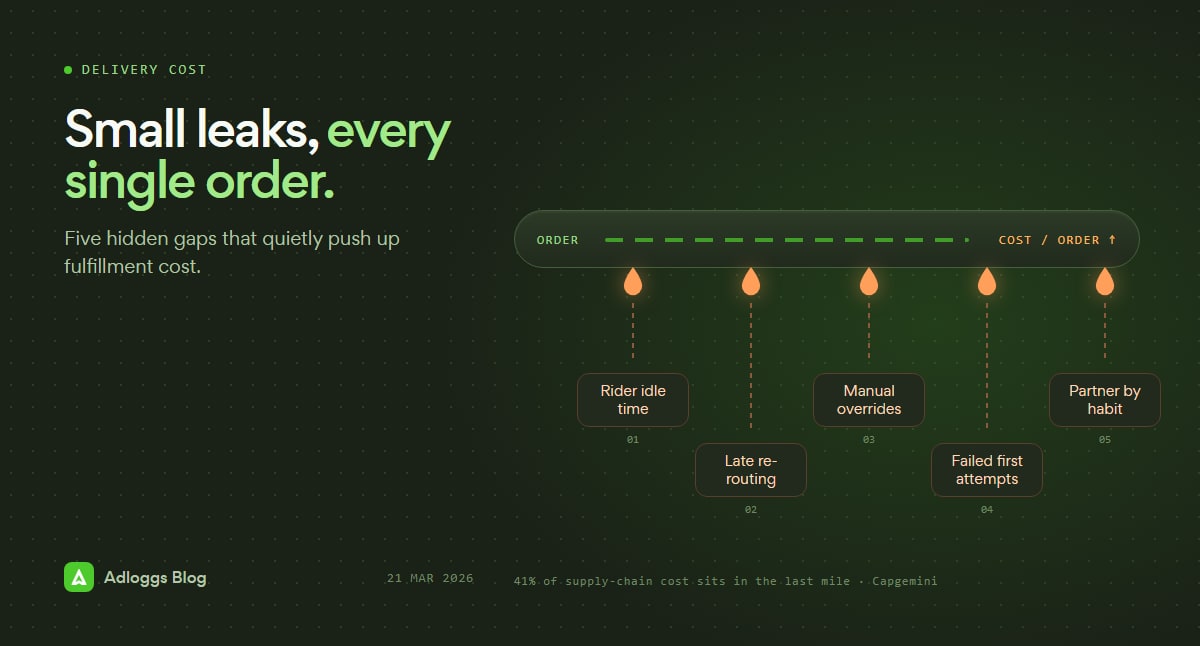
Fulfillment cost rarely fails at the big, visible moments. It fails in the small daily leaks — a rider idling between drops, a route recalculated too late, a dispatcher manually overriding what the system should have caught.
A system outage gets a war room. A rider waiting four minutes for the next assignment gets nothing, because nobody sees it. Yet the last mile already accounts for 41% of overall supply-chain costs in Capgemini’s research, and it is exactly these small, repeated gaps that push that number up.
The arithmetic is unforgiving. Take an illustrative operation doing 3,000 orders a day. If each order carries just two avoidable minutes of rider time, that is 6,000 minutes, or 100 rider-hours lost every day, before anyone notices a problem.
The signal: riders finish a delivery and wait for their next job. The cause: assignment happens one order at a time, after the rider is already free. The fix: plan the next job before the current one ends. Routa batches nearby orders and uses geo-clusters and rider capacity so the next pickup is already on the way.
The signal: riders are re-routed after pickup. The cause: routes are planned once and not updated when a new order, a traffic jam or a kitchen delay changes the picture. The fix: continuous monitoring. ControlX watches every active trip and flags a delay while there is still time to change the plan.
The signal: dispatchers reassigning orders by hand dozens of times a shift. The cause: allocation rules don’t account for live conditions, so people step in. The fix: make the system smarter, not the desk busier. LoggiAI weighs demand, rider availability, traffic, partner performance and cost on every order, so overrides become the exception you review, not the routine.
The signal: “customer not reachable” and “address not found” return trips. The cause: the customer hears nothing between order and doorstep. The fix: confirm before arrival. Zoya sends live updates and answers questions on WhatsApp, and Vox calls when a voice is needed, so the rider arrives to someone who is expecting them.
The signal: one 3PL gets most orders regardless of zone or time. The cause: it is the partner the team knows. The fix: compare cost per order and SLA by partner, by zone, every day, and let allocation follow the numbers across your own fleet and 1PL–4PL partners.
Five numbers, tracked weekly per zone and per partner, show where cost is escaping:
Adloggs real-time analytics reports these by outlet, zone and partner, and root cause analysis traces each spike back to where it started.
You don’t cut fulfillment cost with one big project. You close five small leaks on every order, every day. That is work software should do, and it is exactly the work the Adloggs Agentic AI suite was built for.
Rider time is the largest driver. Idle minutes between drops, routes planned before the latest orders arrive, failed first attempts and choosing a delivery partner by habit rather than by cost and performance all add rider time to every order.
Track five numbers per zone and per partner: idle minutes per rider-hour, the share of orders re-routed after pickup, the dispatcher override rate, first-attempt delivery success and cost per delivered order.
AI agents act on every order in real time. Routa batches and re-plans routes, LoggiAI allocates each order to the fleet or partner with the best cost and SLA fit, ControlX catches delays early, and Zoya and Vox confirm delivery details with customers before the rider arrives.
Examples marked as illustrative show typical scenarios, not results from a specific customer.
Adloggs is an AI-powered delivery Operating System for India and beyond, offering smart delivery orchestration, AI-driven routing, partner aggregation, and hyperlocal logistics for enterprises, QSRs, grocery, pharmacy, restaurant, and ecommerce brands.
Adloggs Technologies Private Limited,
Sri krishna towers, Thirumurugan Nagar Road, Periyar Nagar, Nehru Nagar West, Coimbatore, Tamil Nadu 641048.
© 2026 - 2027 Adloggs All Right Reserved